Signs of a Healthy D2C Business
By Abhishek Goenka and Mahalakshmi Reddy
One big challenge early stage founders face is that in most things, there is no right or wrong answer. It's almost impossible to tell if you're making the right choices, since there are no obvious, traditional indicators like profits or stable revenue growth.
A healthy start-up is very similar to a healthy human body. All the different systems need to work together to achieve complete good health. There are signs we depend on to check if our body is doing okay, and if these signs are in the right range, we aren't too worried. Similarly, there are some objective signs that the business is headed in the right direction. What are these signs?
A peak into an investor's mind might help answer this question. Here are some metrics that we consider the signs of a healthy business-
1) Unit economics: Unit economics is the calculation of how much money the business makes per unit of product sold. It takes into account the cost of making the product, packaging, logistics and marketing costs for one unit. The idea is to have a healthy margin after all these variable expenses for fixed expenses and profits. It's important to have a sense of the industry standards, too. For example, the gross margins for F&B (non-staples) businesses are usually around 40-60%, while for personal care they're higher around 65-75%. However, post adjusting for marketing and consumption patterns, the net contribution margin could be similar for both categories. Unit economics are the heart-beat or pulse of any business. They NEED to make sense from very early on. While there could be fluctuations in the short term, they should be corrected sooner rather than later. For a 100% D2C business, if the unit economics stop making sense, the business stops making sense.
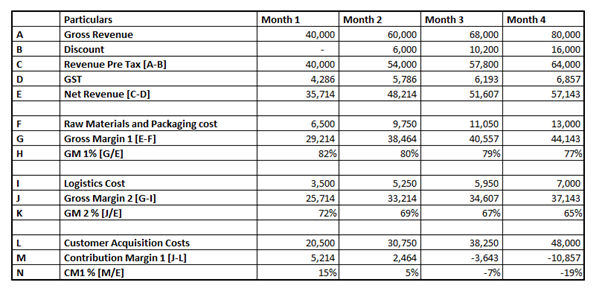
In the example above, while the gross and net revenue of the company has increased over 4 months, the contribution margin has come down from 15% to -19% (row N). The company has increased discounts and spent more money to acquire customers (rows B and L) - an unsustainable approach in the long run. Keeping track of your unit economics, and not just revenue, therefore gives a much clearer picture of the health of a company.
2) Repeat cohorts: A very common misconception is that early stage businesses shouldn't worry too much about repeats; they should solve for customer acquisitions and growth first. But acquisitions and repeats go hand-in-hand. There's no point in spending money on acquiring a customer if you don't have a plan in place to retain them, especially because the cost of retaining a customer is around 10-20% of the cost of acquiring one.
Most businesses track the number of repeat customers as a percentage of total customers, as shown below. In the month of January, out of a total of 1,033 customers, 82 are not first time customers. The repeat percentage appears to increase from 8% to 15%.

While this is a decent short-term indicator, repeat cohorts, i.e. the calculation of the percentage of customers that are returning after a specific period of time, are a much better metric.
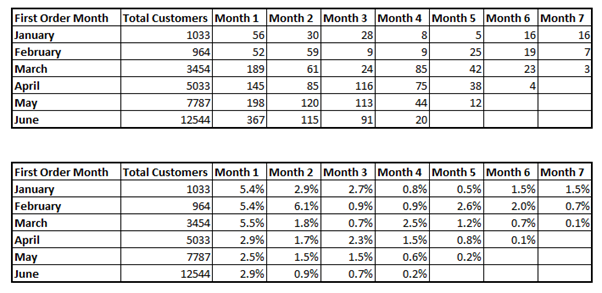
For example, in the image above of a company deriving all its revenues from its own website, 5.4% of the customers that were acquired in January returned in 1 month. However, only 2.9 of the customers acquired in June are returning in 1 month. We also see that the 2-month retention has gone down from 2.9% in January to 0.9% in June. These are indicators that retention efforts need to be upped. Repeat cohorts therefore give a more accurate, real story of the business when compared to simple repeat percentages.
Repeat cohorts are not only an indication of good health, but also give an insight into customer psyche, and help make the right decisions with respect to product SKU, sizing or pricing decisions.
Repeats are like the blood pressure of a business. It's easy to fall off the wagon, but can be corrected with some work. If they drop too low, there's something seriously off about the business, possibly even life-threatening.
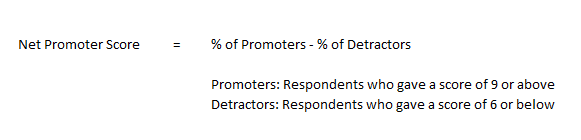
3) National Promoter Score or NPS: NPS is one of the most underrated metrics out there. It is calculated based on one question that brands ask consumers- “On a scale of 1 to 10, how likely are you to recommend this product to a friend?” Today, when brand loyalty is at its lowest, a customer remembering your brand and recommending it is a great sign.
NPS is a lot like cholesterol or blood sugar levels (except that no amount of high NPS score is bad for the business). It should ideally be splendid at the beginning of the business. If it does deteriorate, it takes some time and serious changes to improve again. As the business gets older or achieves scale, its gets challenging to maintain a healthy score. For those that are able to, it is one of the strongest moats.
4) Customer Acquisition Costs: Customer Acquisition cost is the largest variable in your unit economics. It's usually the major delta between a company making profits and a company burning money, given the industry and stage are the same.

The best way to go about it would be to pilot acquisition strategies for few independent customer groups, communication statements or price points that could work for your brand, run campaigns around these, and track CACs for each funnel.
For example, if Maggi were a D2C brand today, this is what this exercise would look like. Since we know which communication statement and target group works best, the marketing strategy and budget can be planned accordingly.
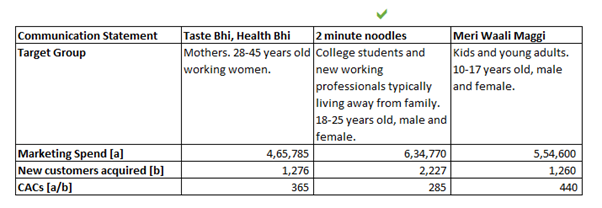
Almost all businesses, irrespective of scale and industry, struggle with maintaining stable CACs today because of immense competition and limited channels for advertising. Identifying and exploring newer channels where your TG is present, and re-targeting customers innovatively and effectively, are good ways to reduce CACs.
CACs are like body fat percentage. They are highly volatile, can increase drastically around the festive season, and are as difficult to maintain as they are to achieve. Body fat can be reduced considerably in the long run with consistent exercising, just like CACs can be reduced with good, consistent branding.
5) Branding: The most subjective, intangible metric. What makes it complicated is the fact that we cannot measure the impact of good branding initiatives based on immediate sales – its true effect is seen only in the medium to long term. The easiest way to understand branding- think of your brand as a person and attribute some qualities to the person on day 1- what does this person believe in? What do they talk like? What principles do they value? Everything that your brand says or does should now be in-line with this personality you've created- from creatives to logo to social media captions to even the way you respond to comments and messages. The results are not seen instantly, but consistently staying true to your brand can do miracles in the long run.
For example, The Souled Store's brand has a very fun, witty, boy-next-door personality, while Skinkraft's approach is a more serious, science and information focused personality, and we can see these tones of voice throughout.


Branding is exactly like working out. We need to make a plan, and consistently stick to it without worrying about the results to reap insane benefits in the medium to long term. Everyone knows it needs to be done consistently, but most people either ignore it or treat it like a short term new year resolution.
If these metrics are at satisfactory levels, the business is healthy. We believe every founder should deeply understand, track like a hawk, and strive to improve these numbers in a planned and sustainable fashion- just like someone who's serious about their health undergoes regular health check-ups and constantly works on getting healthier!
P.S- Shoutout to Vedang Patel, Founder of The Souled Store, for his interesting inputs on the topic.